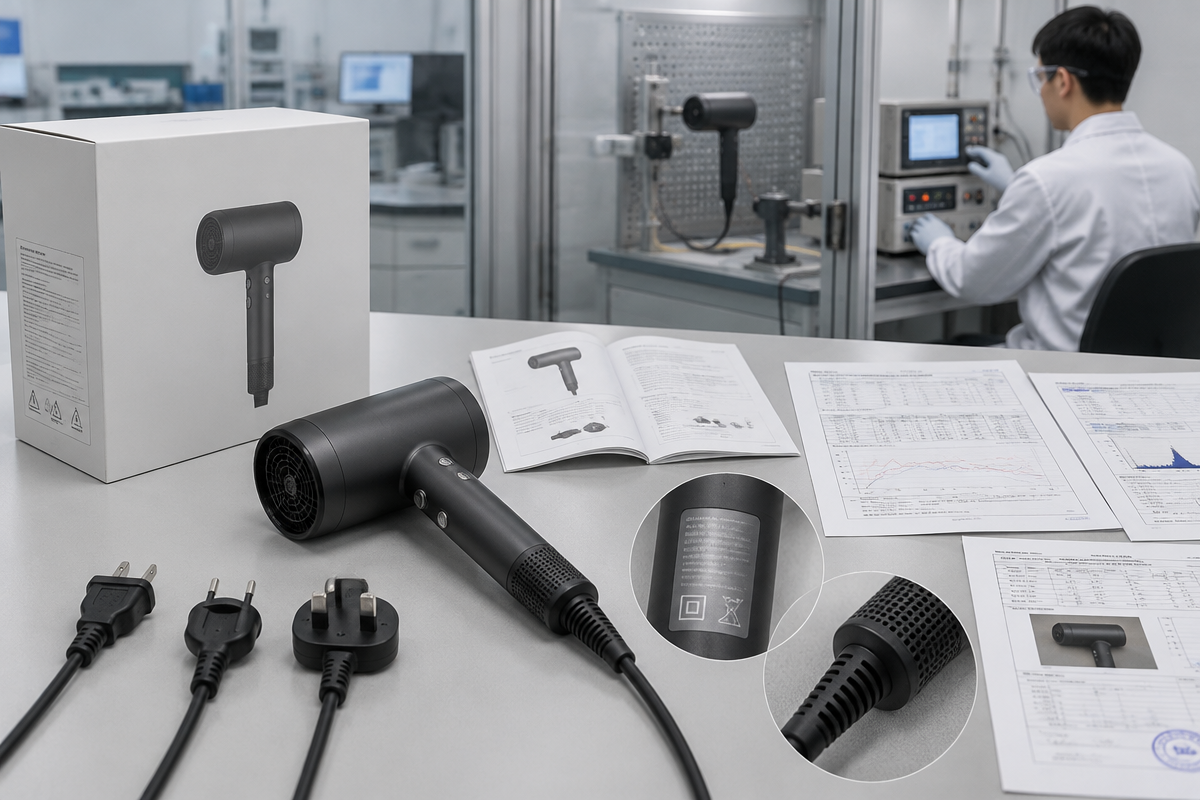
A low-priced hair dryer can become expensive when unstable performance, excessive returns, delayed deliveries, and compliance problems begin damaging your business.
A high-speed BLDC hair dryer is worth sourcing in bulk when it delivers efficient drying, controlled heat, durable performance, market-ready compliance, consistent production quality, and enough customization potential to support profitable brand growth.
However, the words “high speed” alone do not make a hair dryer a good sourcing choice. Buyers must look beyond the motor speed printed on the specification sheet. The real value comes from the complete system: motor, airflow structure, heating control, electronic design, housing, noise management, quality control, certification support, and supplier capability.
Importers, distributors, e-commerce sellers, and private-label brands can start by reviewing a manufacturer’s complete range of
OEM and ODM hair dryers.
This makes it easier to compare different motors, structures, accessories, and market positions before requesting samples.
Why Does the BLDC Motor Matter in a Bulk Hair Dryer Order?
A powerful sample may look impressive, but inconsistent motors can create noise, vibration, weak airflow, overheating, and expensive returns after mass production.
A well-engineered BLDC motor can provide fast airflow, compact construction, better operating efficiency, and a longer service life. For bulk buyers, its main value is consistent performance across large production quantities.
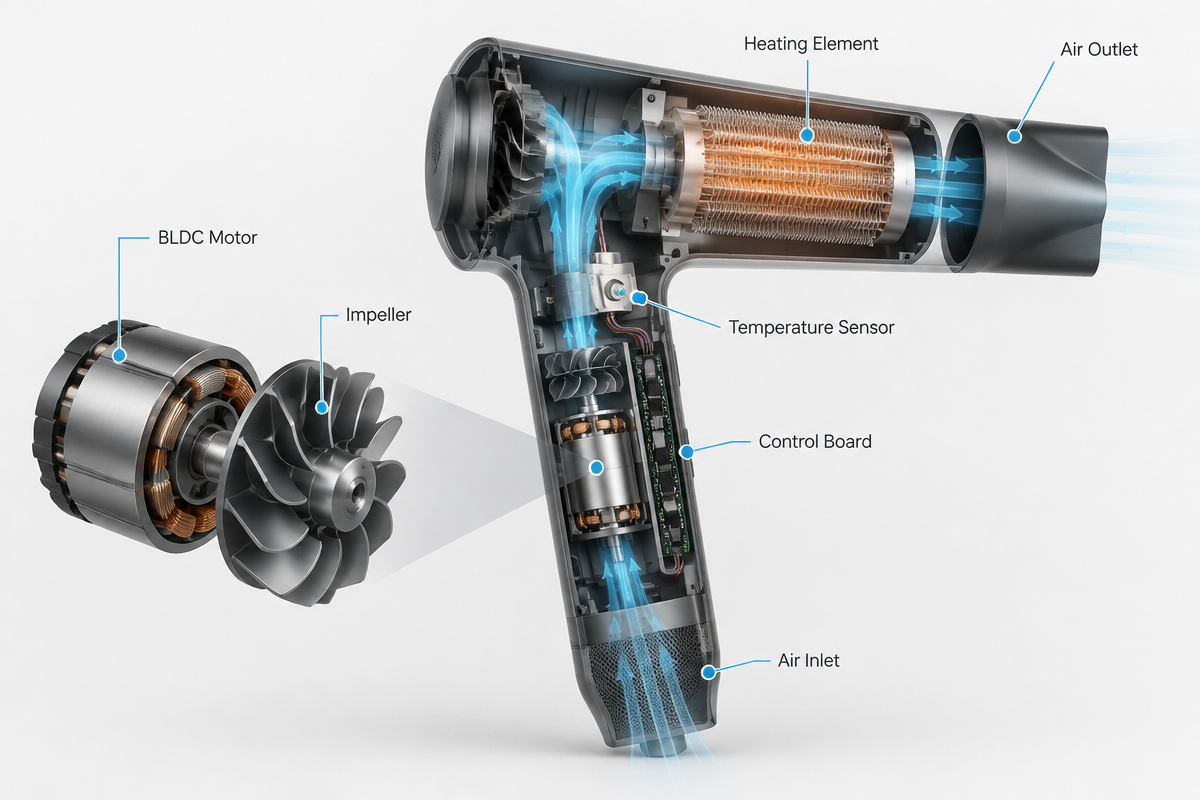
BLDC stands for brushless direct current. Unlike a traditional brushed motor, a BLDC motor does not depend on carbon brushes for mechanical commutation. Electronic control manages the motor’s operation instead.
This difference supports several advantages that are important in professional and consumer hair dryers:
- Higher rotational speed potential
- Strong airflow from a compact structure
- Reduced mechanical wear
- Better energy-conversion efficiency
- More stable speed control
- Lower vibration when correctly balanced
- Greater flexibility for slim and lightweight designs
These advantages should be evaluated at the product level rather than treated as isolated motor specifications. A fast motor cannot compensate for a poorly designed air inlet, a restrictive internal air channel, an unstable control board, or an unsuitable heating system.
Buyers can use the
MK-6163 BLDC high-speed hair dryer
as one reference when reviewing how the motor, product structure, controls, and private-label options can be integrated into a sourcing-ready product.
What Should Buyers Verify?
Before approving a bulk order, ask the supplier to explain:
- Who manufactures the motor?
- How is each motor inspected before assembly?
- How is rotational balance controlled?
- What durability testing has been completed?
- How does the control board protect the motor?
- Is motor performance consistent across different voltage versions?
- What happens if the air inlet is partially blocked?
- How are unusual noise and vibration detected?
- Is the mass-production motor identical to the sample motor?
- How are motor and component batches recorded and traced?
The samples supplied for approval should represent the planned mass-production configuration. A prototype using a different motor, circuit board, heating element, or housing material does not provide reliable evidence for a purchasing decision.
| Motor Evaluation Area | Why It Matters in Bulk Sourcing | What Buyers Should Request |
|---|---|---|
| Speed stability | Affects airflow consistency and user experience | Multi-unit sample comparison |
| Motor balance | Influences vibration, noise, and durability | Vibration and noise inspection method |
| Electronic control | Supports smooth operation and product protection | Control-board specifications and test plan |
| Heat resistance | Helps maintain performance during extended operation | Temperature-rise and endurance test records |
| Batch traceability | Makes quality problems easier to investigate | Motor and critical-component batch records |
A qualified manufacturer should be able to discuss the motor as part of the complete engineering system. If a supplier can only repeat a high RPM figure without explaining airflow, durability, heat management, or testing, further technical review is necessary.
Does Faster Airflow Automatically Mean Better Drying Performance?
Motor speed attracts attention, but poorly controlled airflow may feel harsh, create excessive noise, or fail to remove water efficiently from the hair.
Effective drying depends on airflow speed, air volume, temperature, nozzle design, and heat distribution working together. Buyers should compare actual drying performance instead of choosing a model based only on RPM.
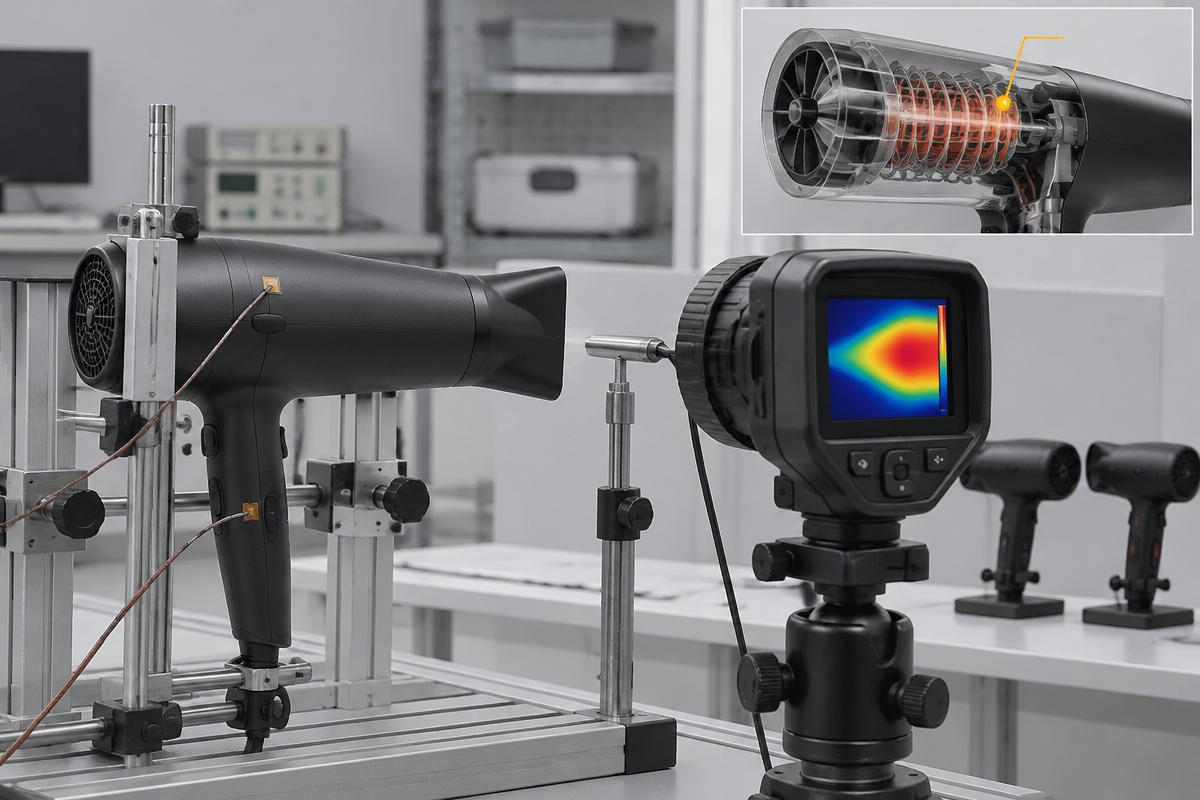
A high-speed hair dryer should move air efficiently through its internal structure and direct it toward the hair with minimal turbulence. The air inlet, impeller geometry, motor position, heating element, outlet, and nozzle all influence the final result.
Two models using motors with similar speed claims can produce very different user experiences. One may deliver concentrated and stable airflow. Another may produce uneven air pressure, irritating sound, or excessive surface heat.
How Should Buyers Evaluate the Airflow System?
Procurement teams can compare products using practical tests:
- Measure airflow at the same speed setting.
- Compare drying time on equal hair samples or standard testing materials.
- Check whether airflow remains stable after extended operation.
- Evaluate performance with and without the concentrator nozzle.
- Test every heat and speed combination.
- Observe whether the body or handle becomes uncomfortable to hold.
- Listen for sharp, irregular, or fluctuating motor sounds.
- Check whether long hair can be drawn toward the air inlet.
- Compare several samples from the same production batch.
- Repeat the test after continuous operation.
Airflow should also match the intended customer group. A salon professional may prefer powerful, concentrated airflow for rapid section drying. A home user may place more value on comfort, lower perceived noise, simple controls, and protection from excessive heat.
Accessories also affect perceived performance. A concentrator nozzle supports targeted styling, while a diffuser distributes air across a wider area for curly or textured hair. These accessories require secure fitting, suitable heat resistance, and stable positioning during use.
Procurement teams should therefore define the expected user scenario before requesting samples. “We need a high-speed dryer” is too broad. A useful product brief should identify:
- Target customers
- Main hair types
- Typical styling habits
- Sales channels
- Preferred product weight
- Control layout
- Accessory requirements
- Retail price position
- Packaging requirements
- Target-market voltage and plug type
Buyers can compare these requirements against the manufacturer’s
high-speed hair dryer range
before selecting models for testing.
How Important Are Heat Control and Hair Protection Features?
Fast airflow may shorten drying time, but unstable temperature control can cause discomfort, damage the user experience, and increase complaints about dryness or overheating.
A sourcing-worthy hair dryer should combine rapid airflow with responsive temperature management. Sensors, control algorithms, heating components, and safety protection must work together to deliver stable and repeatable output.
Heat is necessary for efficient drying and styling, but higher temperature does not always mean better performance. When airflow is already strong, controlled heat can help remove moisture without relying on extreme outlet temperatures.
This is particularly important for premium brands. Customers buying an advanced BLDC hair dryer often expect more than quick drying. They may also expect comfortable heat, smooth-looking hair, reduced static, simple mode selection, and consistent performance.
Procurement teams can review this guide to
hair dryer temperature and heat control
to understand why temperature performance should be evaluated together with airflow and user comfort.
What Temperature-Control Questions Should Buyers Ask?
- How is outlet temperature monitored?
- Does the model use a temperature sensor?
- How frequently does the system adjust heating output?
- Is the heating element matched to each voltage version?
- What protection is included against overheating?
- How does the product respond when airflow is restricted?
- Are the heat settings clearly different and repeatable?
- Is there a cool-shot or cool-air function?
- How are abnormal conditions tested during production?
- Does temperature performance remain consistent across multiple units?
Ionic technology is another common feature in high-speed hair dryers. It is often positioned as a way to reduce static and support smoother-looking hair. Buyers should avoid relying only on broad marketing claims. The supplier should be able to explain the test method and confirm that the ion generator used in production matches the approved sample.
The control interface also affects product value. Buttons should be easy to understand and positioned to reduce accidental changes during use. Indicator lights must remain visible without making the product unnecessarily complicated.
Private-label projects may consider control options such as:
- Separate heat and speed buttons
- Combined mode controls
- LED temperature indicators
- Setting-memory functions
- Cool-air modes
- Intelligent hot-and-cold cycles
- Travel-lock functions where technically appropriate
Each added feature introduces cost and potential failure points. The best specification is not necessarily the one with the most functions. It is the one that offers meaningful benefits to the target customer and can be manufactured consistently.
Should Buyers Consider Compact and Dual-Voltage Designs?
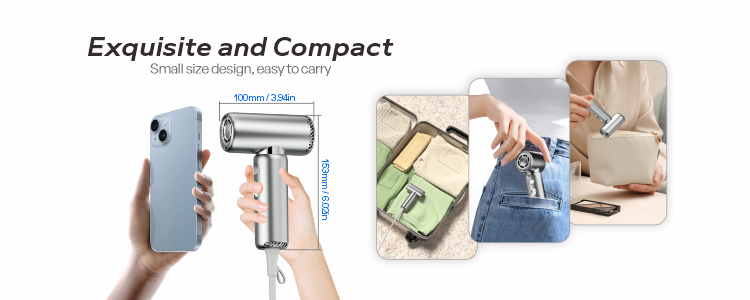
A standard high-speed dryer may perform well at home, but frequent travelers and internationally mobile users may need a smaller product with wider voltage compatibility.
Compact and dual-voltage models can create a differentiated product opportunity, but buyers must verify voltage switching, heating performance, plug compatibility, weight, airflow, and market-specific compliance.
Travel-oriented products require more than simply reducing the housing size. The manufacturer must balance motor performance, heating output, internal spacing, heat resistance, noise, weight, and safety.
A smaller housing can create additional engineering challenges. Internal components may be closer together, making heat management and airflow efficiency especially important. Buyers should test compact products under every supported voltage condition rather than assuming performance will be identical.
This
mini dual-voltage high-speed hair dryer
demonstrates how portability, voltage compatibility, airflow, and ionic positioning can be combined in one private-label product concept.
When evaluating a travel-oriented model, ask:
- Is voltage selection automatic or manual?
- Are heat and airflow consistent under each supported voltage?
- Which plugs or adapters are supported?
- Does the product require different compliance documents for each market?
- Is the unit compact enough for its intended travel scenario?
- Does the power cord fit the portability concept?
- Can the packaging protect the product during frequent transport?
- Are the controls easy to operate on the smaller housing?
Dual-voltage capability can create commercial value, but it should never be treated as a marketing label alone. The exact electrical configuration must be tested and reviewed for each destination market.
Which Quality Tests Should Be Completed Before Mass Production?
A good-looking approval sample does not guarantee that thousands of units will perform consistently. Weak production control can turn minor component variation into widespread customer complaints.
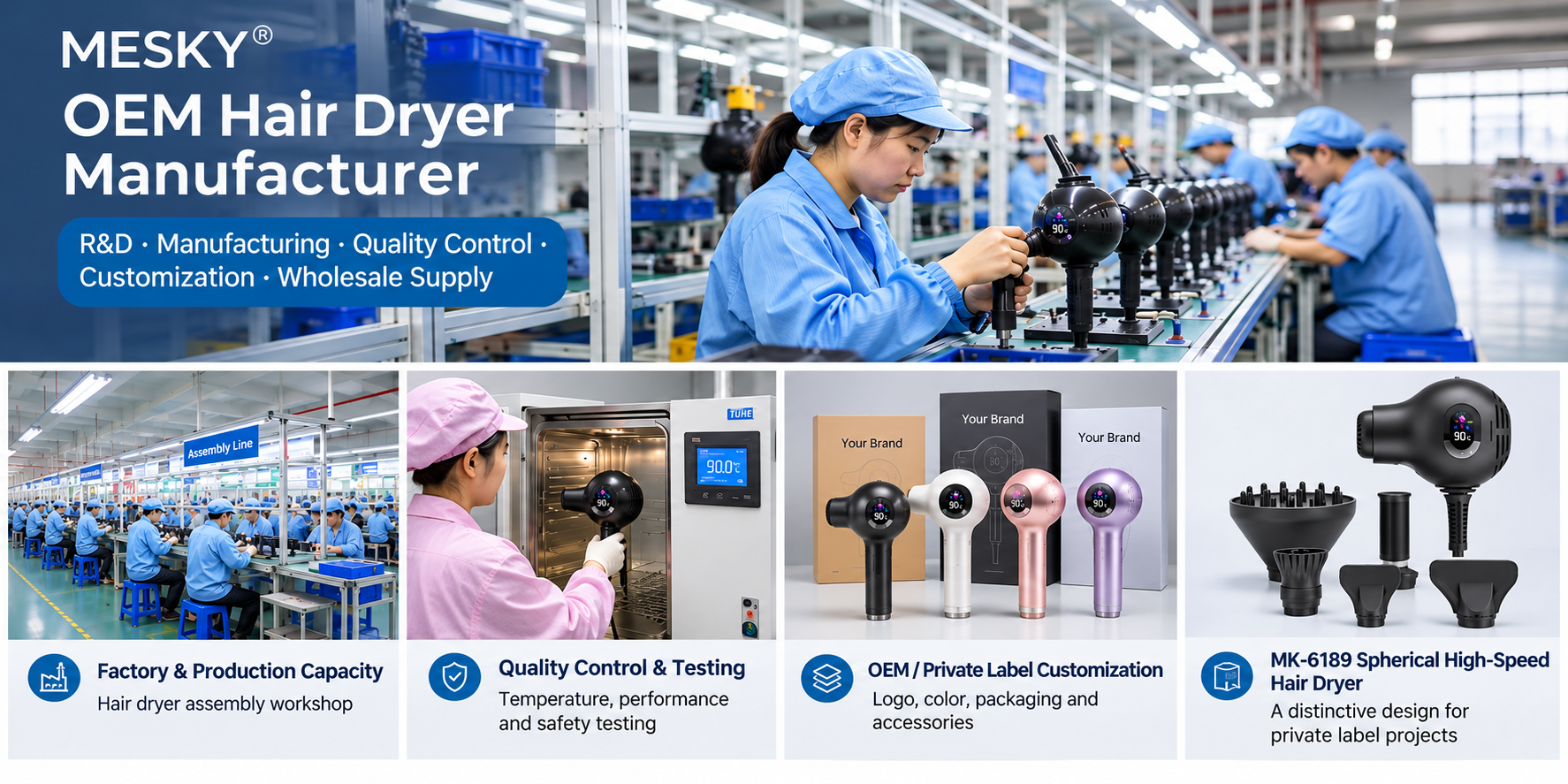
Bulk orders require documented incoming inspection, in-process control, functional testing, safety checks, appearance standards, and final inspection. Buyers should agree on test and acceptance criteria before production begins.
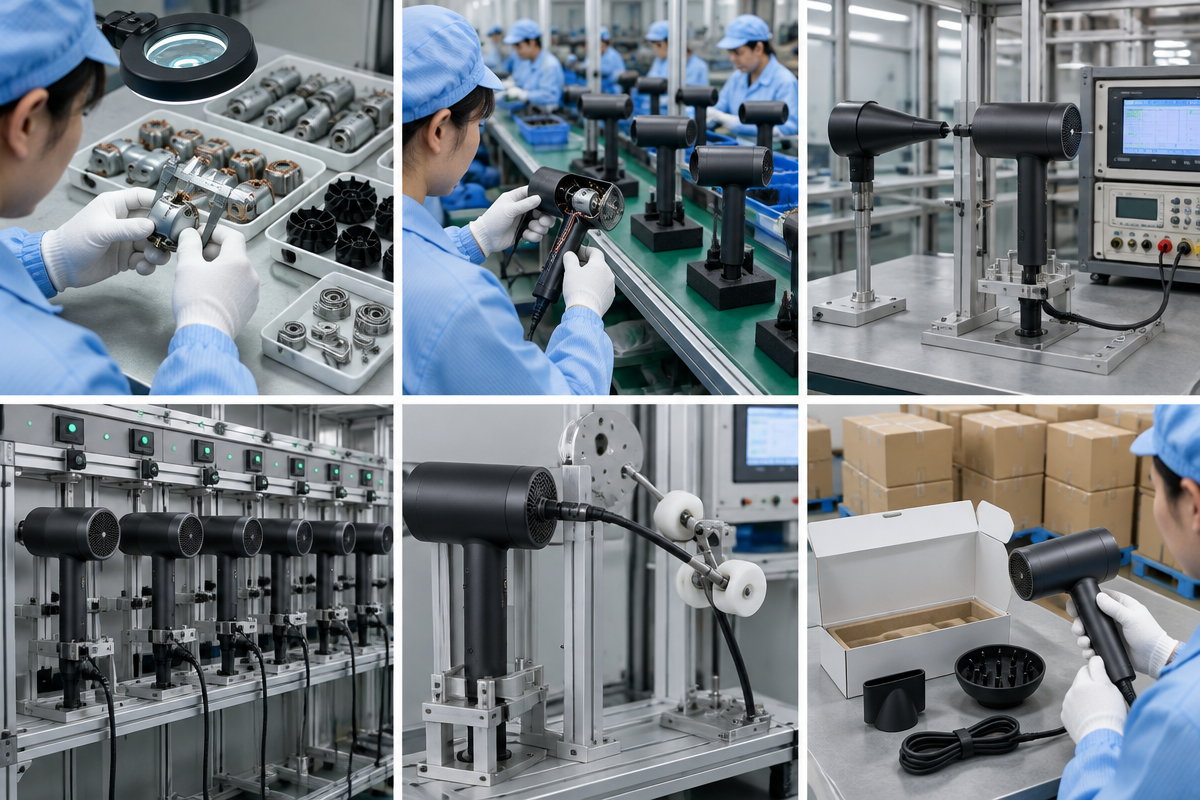
Quality control should begin before assembly. Motors, heating components, power cords, switches, circuit boards, housings, magnets, filters, and accessories all need suitable inspection procedures.
During production, workers and quality teams should check whether parts fit correctly and whether electrical connections, screws, wiring, insulation, and internal components meet the approved standard. Final testing should confirm that the finished unit works across every intended mode.
| Quality-Control Stage | Typical Inspection Focus | Buyer Benefit |
|---|---|---|
| Incoming material inspection | Motors, PCBs, cords, heating parts, plastics, and accessories | Reduces defective components entering production |
| First-article inspection | Assembly, appearance, dimensions, and functions | Confirms production matches the approved sample |
| In-process inspection | Wiring, fastening, fitting, and internal assembly | Detects problems before final assembly |
| Functional testing | Heat, speed, buttons, lights, ionic function, and cool air | Confirms normal operation |
| Safety testing | Electrical protection, insulation, and abnormal operation | Supports safer market entry |
| Appearance inspection | Color, finish, printing, gaps, and scratches | Protects brand presentation |
| Packaging inspection | Accessories, manuals, labels, and cartons | Prevents missing parts and packaging errors |
| Pre-shipment inspection | Sampling against agreed requirements | Provides final order verification |
Durability Testing Should Reflect Real Use
A high-speed dryer may be switched on and off repeatedly, operated at maximum settings, used in humid environments, dropped onto a dressing table, or packed for travel. Testing should consider reasonably foreseeable use rather than ideal laboratory conditions alone.
Depending on the model and target market, the validation plan may include:
- Continuous operating tests
- Repeated switch tests
- Power-cord bending tests
- Button life tests
- Drop or impact tests
- Nozzle attachment tests
- Filter removal and installation tests
- Heating and cooling cycle tests
- Abnormal airflow-restriction tests
- Packaging transportation tests
Buyers should define acceptance criteria before placing the mass-production order. These criteria should cover appearance limits, functional requirements, packaging details, inspection sampling, and procedures for handling defective units.
Golden samples are particularly useful. A signed and approved sample gives the buyer, supplier, and inspection team a shared reference for color, surface finish, sound, airflow, controls, accessories, branding, and packaging.
What Certifications and Market Requirements Should Buyers Check?
A dryer designed for one country may not be ready for another. Voltage, plugs, labeling, safety standards, and documentation can affect whether the order can be legally sold.
Buyers should match the exact product configuration with the requirements of the destination market. Never assume that one certificate, test report, or product version covers every country and sales channel.
Hair dryers are electrical appliances used close to the body, often in bathrooms or other humid environments. This makes safety and compliance essential parts of sourcing.
Required documents vary by destination country, product configuration, plug type, voltage, and sales channel. Depending on the specific product and target market, a supplier may support certifications or test requirements such as ETL, FCC, UL859, CETL, CE, RoHS, PSE, KC, CB, UKCA, SAA, INMETRO, NOM, or GCC.
Buyers must verify which documents apply to the selected model. The presence of certification logos on a supplier’s website does not automatically mean that every product is covered.
Confirm the Exact Certified Configuration
Before relying on a certificate or test report, compare it with:
- Model number
- Rated voltage and frequency
- Rated power
- Plug and power cord
- Motor and heating system
- Housing and critical components
- Applicant and manufacturer details
- Product markings
- Report issue date and validity
- Destination-country requirements
Changes made during customization can also affect compliance. A new plug, heating component, circuit board, housing material, or internal structure may require additional evaluation.
Packaging and documentation deserve equal attention. Product labels, warning statements, user manuals, importer information, recycling marks, and language requirements should be reviewed before printing begins.
Compliance review should be completed early in the OEM or private-label process. Waiting until production is finished can lead to rework, shipment delays, relabeling costs, or inventory that cannot be sold in the intended market.
How Can Buyers Calculate the Real Value of a Bulk BLDC Hair Dryer?
The lowest quotation may look attractive, but component failures, returns, rework, slow delivery, and poor after-sales support can quickly remove the initial savings.
Evaluate total landed and operating cost rather than unit price alone. A better dryer can create value through stronger positioning, fewer defects, lower return risk, repeat orders, and a longer commercial life.
The purchase price is only one part of the sourcing decision. Buyers should calculate the complete commercial impact of the order.
Include These Cost Areas
- Product unit price
- Custom colors and surface treatments
- Logo application
- Packaging design and printing
- Tooling or private-mold investment
- Testing and certification
- Spare parts or replacement units
- Inspection expenses
- Freight, insurance, and import charges
- Warehousing and fulfillment
- Warranty handling
- Customer returns
- Marketing content and product photography
- Future reorder costs
Quality influences revenue as well as cost. A visually distinctive, comfortable, and reliable dryer can support stronger product reviews and more confident retail positioning. In contrast, a generic product with unstable performance can force a brand to compete mainly on price.
Buyers should also evaluate supplier responsiveness. During a private-label project, questions and changes are normal. Slow communication can delay artwork approval, sampling, testing, packaging, production, and shipment.
A qualified supplier should provide a clear process covering:
- Requirement review
- Product recommendation
- Sample confirmation
- Engineering evaluation
- Branding and packaging development
- Compliance review
- Pre-production approval
- Mass production
- Quality inspection
- Shipment and after-sales support
Buyers comparing potential partners can also review this
hair dryer manufacturer comparison guide
for additional criteria related to manufacturing capabilities, product positioning, and private-label support.
What Should You Ask a BLDC Hair Dryer Manufacturer Before Ordering?
Sales presentations often highlight product appearance and motor speed while avoiding the engineering, capacity, compliance, and quality details that determine whether a bulk order succeeds.
Ask questions that reveal how the factory manages components, testing, customization, certification, production capacity, defect handling, and repeat orders. Clear answers reduce sourcing risk before money is committed.
Product and Engineering
- Which components determine airflow and temperature performance?
- Can the supplier explain the motor and control-board design?
- Which parts can be customized without affecting safety?
- Can the factory support different voltage and plug versions?
- How are noise and vibration managed?
- What product validation is completed before production?
- How are engineering changes documented?
- Does the factory have experience with similar sales channels?
Quality and Compliance
- What inspections are performed on incoming components?
- Is every finished dryer function-tested?
- Can the supplier provide reports for the exact model?
- How are defective units identified and recorded?
- Can buyers arrange third-party inspections?
- How are changes controlled after sample approval?
- What is the procedure for investigating a field failure?
- How are corrective and preventive actions recorded?
Production and Delivery
- What is the realistic production capacity for the selected model?
- Which components have the longest lead time?
- How are peak-season orders scheduled?
- How does the factory prevent unauthorized material substitutions?
- What information can be traced by production batch?
- How are production delays communicated?
- Is there a clear reorder process?
- How is packaging-material availability managed?
OEM and Private-Label Support
- Which logo application methods are available?
- Can the supplier match custom colors?
- Are custom packaging and manuals supported?
- Can accessories or control functions be modified?
- Is private-mold development available?
- Who manages the project from sampling to shipment?
- Which customization changes may affect certification?
- What files must the buyer provide for packaging development?
Buyers can use the
Mesky hair dryer manufacturing and OEM/ODM range
to identify potential configurations before discussing branding, packaging, accessories, samples, and mass-production requirements.
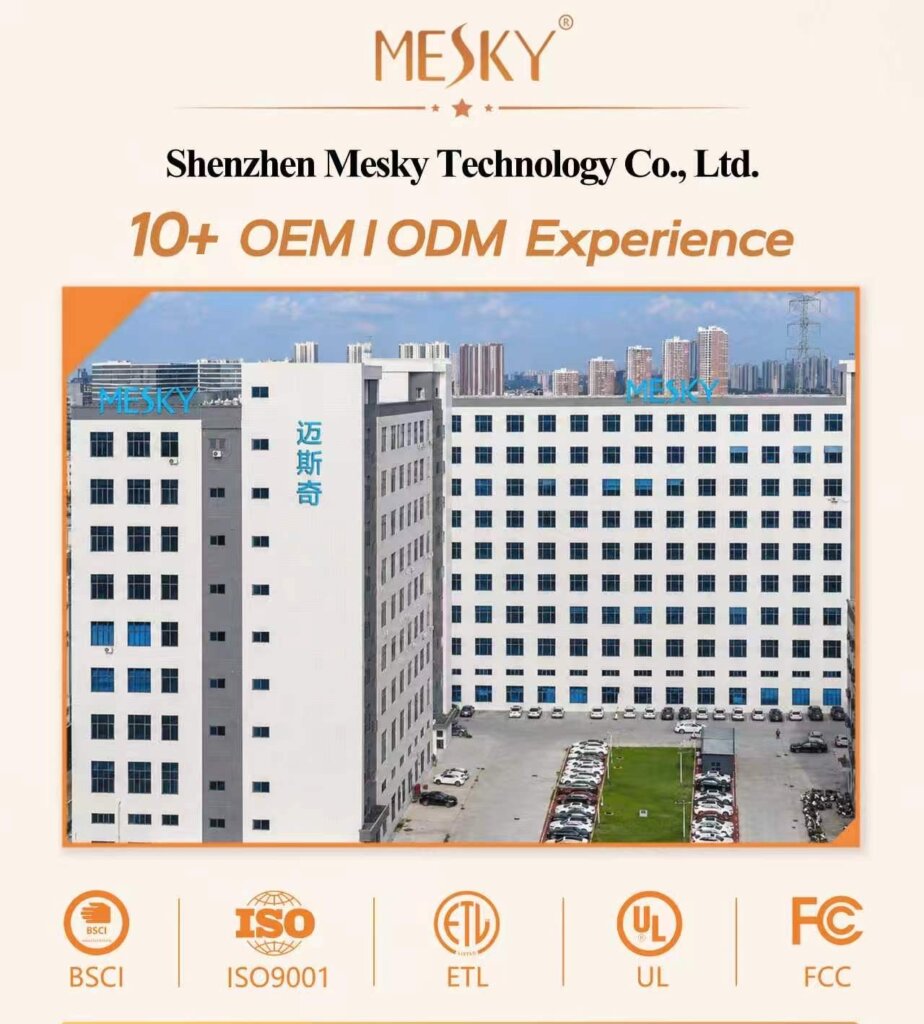
Factory size, patents, certifications, and production capacity are useful indicators, but the final decision should still be based on approved samples, technical documents, compliance suitability, quality standards, inspection procedures, and clear commercial terms.
Conclusion
A high-speed BLDC hair dryer is worth sourcing in bulk when its engineering, heat control, compliance, production quality, customization options, and total cost support sustainable brand growth.
Explore
Mesky’s hair styling tools and OEM/ODM capabilities
or review the
high-speed hair dryer collection
to identify suitable products for sampling, customization, and bulk-order evaluation.
Last Updated on 10/27/2026 by sales04