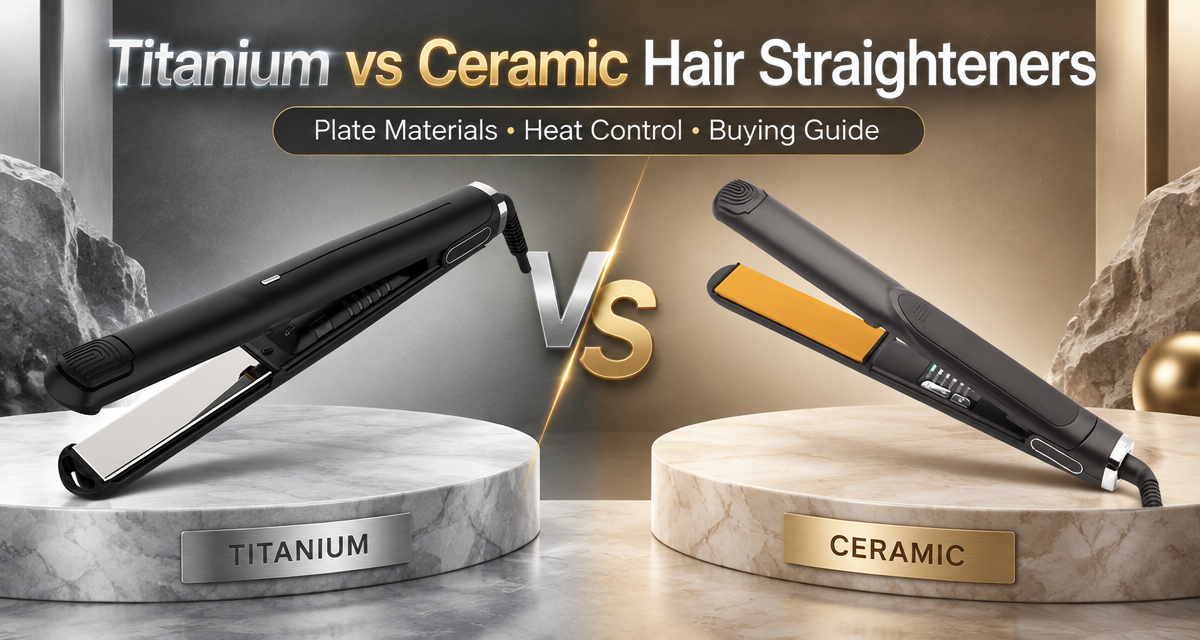
Titanium vs Ceramic Hair Straighteners: Which Is Better?
When comparing titanium vs ceramic hair straighteners, the best choice depends on more than the plate material. Hair type, temperature control, heating performance, plate construction, and styling habits all affect how a flat iron performs.
Titanium straighteners are often selected for smooth plate surfaces and efficient heat transfer, while ceramic straighteners are popular for their styling feel and availability across many product designs. However, neither material is automatically better, safer, or more suitable for every hair type.
For consumers, the goal is to choose a straightener that works well at an appropriate temperature. For beauty brands, wholesale distributors, and importers, the decision also involves product specifications, target customers, quality testing, and OEM/ODM customization.
In this guide, we compare titanium and ceramic hair straighteners and explain what buyers should consider before choosing a product.
1. Titanium vs Ceramic Hair Straighteners: Quick Comparison
Here is a practical overview of the differences between titanium and ceramic flat irons.
| Comparison Factor | Titanium Hair Straightener | Ceramic Hair Straightener |
|---|---|---|
| Plate Material | Titanium or a titanium-based surface, depending on construction | Ceramic or a ceramic-coated surface, depending on construction |
| Heat Transfer | Titanium is a thermally conductive metal | Ceramic performance depends on the specific material and plate structure |
| Heat-Up Speed | Depends on the heater, plate construction, and temperature control | Depends on the heater, plate construction, and temperature control |
| Styling Feel | Can provide a smooth, low-friction styling surface | Can also provide a smooth styling surface |
| Temperature Settings | Vary by product model | Vary by product model |
| Hair Type Considerations | Often considered for thick or difficult-to-style hair | Often considered for fine or delicate hair |
| Durability | Depends on plate construction, surface treatment, and use | Depends on ceramic quality, coating, and use |
| Price | Depends on specifications, components, and brand positioning | Depends on specifications, components, and brand positioning |
The key difference: Titanium and ceramic are different plate materials, but the quality of the complete straightener determines how consistently and effectively it performs.
A well-designed ceramic straightener may outperform a poorly controlled titanium model, and vice versa.
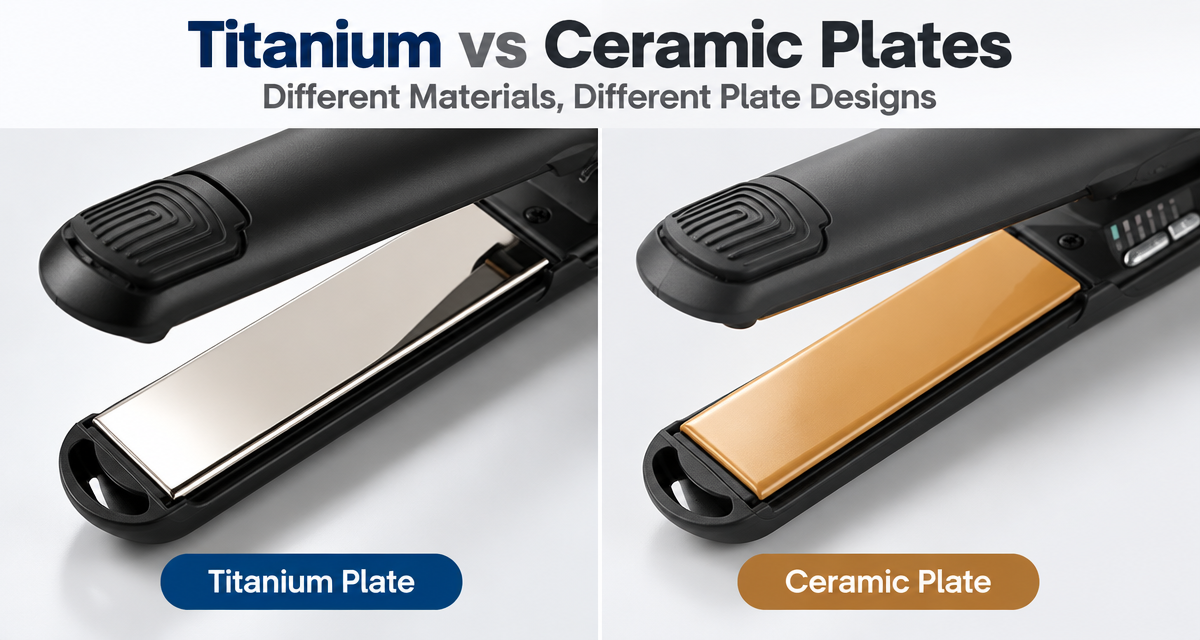
2. How Do Titanium and Ceramic Straightener Plates Work?
Understanding plate construction is important because not every straightener marketed as titanium or ceramic uses the same internal structure.
Titanium Hair Straightener Plates
Titanium is a metal with useful heat-transfer properties.
In a hair straightener, titanium may be used as part of the plate structure or as a surface layer, depending on the product design.
Titanium plate designs can offer a smooth contact surface for styling. Their performance, however, depends on the heating element, temperature sensor, plate thickness, and overall construction.
For buyers evaluating titanium flat irons, it is useful to check whether the product uses a titanium plate, titanium coating, or another construction method.
Ceramic Hair Straightener Plates
Ceramic is also widely used in hair straightener designs.
Some products use ceramic components, while others use ceramic coatings over a different base material.
Ceramic plate designs can provide a smooth styling surface and are available in a wide variety of flat iron models.
As with titanium, the final performance depends on the specific ceramic material, coating quality, heater, and temperature control system.
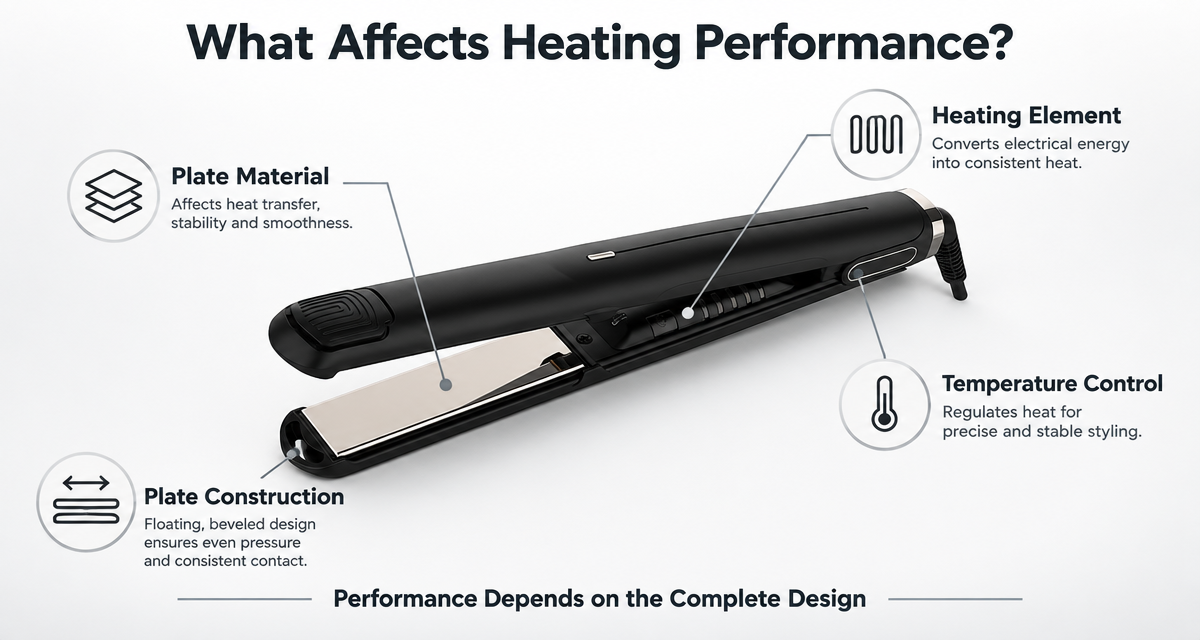
Why Plate Construction Matters
Two straighteners with the same advertised plate material can perform differently.
Factors that influence performance include:
- Plate dimensions and thickness
- Heating element design
- Temperature sensor placement
- Surface finish
- Contact pressure and floating plate movement
- Quality of materials and assembly
For private label brands, confirming the actual plate construction is more useful than selecting a product based only on the words “titanium” or “ceramic.”
3. Which Heats Up Faster: Titanium or Ceramic?
Titanium is often associated with fast heat transfer, but the time required for a flat iron to reach its selected temperature cannot be determined from plate material alone.
A hair straightener’s heat-up time also depends on its heating element, power design, thermal mass, and control system.
Heating Elements Matter
Hair straighteners may use different heating technologies, including MCH (Metal Ceramic Heater) and PTC-based systems.
The heater generates and transfers heat to the plates. The temperature control system regulates how that heat is maintained during operation.
Therefore, a manufacturer should provide model-specific heat-up data rather than claim that every titanium straightener heats faster than every ceramic model.
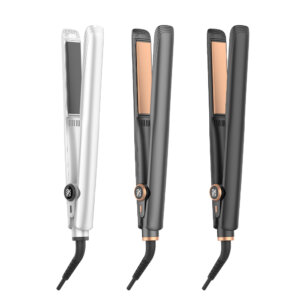
Real Product Example: MESKY MK-128
The MESKY MK-128 Nano Titanium Hair Straightener uses an MCH heating system.
According to its product specifications, the MK-128 offers:
- Nano titanium plates
- Heat-up to 240°C in 40 seconds
- Five LED temperature settings: 140°C, 160°C, 180°C, 200°C, and 240°C
- Automatic dual voltage: 100–240V, 50/60Hz
- 2.5m swivel cord
- 60-minute automatic shut-off
These are specifications for the MK-128, not performance claims for every titanium straightener.
Explore the MK-128 Nano Titanium Hair Straightener
4. Titanium vs Ceramic: Temperature Control and Heat Distribution
Temperature control is one of the most important factors when comparing hair straighteners.
A product should not be judged only by its maximum temperature.
Adjustable Temperature Settings
Different hair types and styling needs may require different settings.
A straightener with adjustable temperature control gives users more flexibility than a model with only one fixed setting.
For brands and distributors, relevant specifications include:
- Available temperature settings
- Temperature adjustment method
- Heating accuracy
- Temperature recovery during styling
- Maximum operating temperature
- Automatic shut-off functionality
These features should be checked against the actual product specifications.
Heat Distribution
Both titanium and ceramic straighteners can be designed to provide consistent heat across the plate surface.
However, neither material guarantees perfectly uniform heating.
Uneven heating may be affected by heater placement, plate construction, control accuracy, or component quality.
If uniform temperature is an important product selling point, buyers should request relevant test information for the specific model.
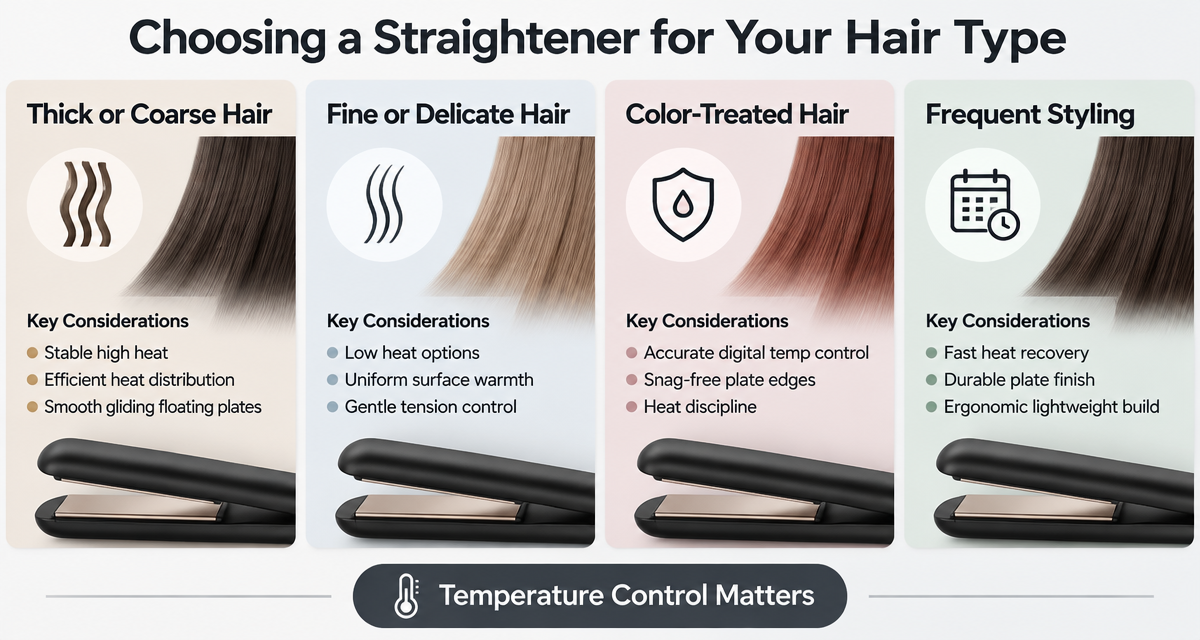
5. Which Is Better for Different Hair Types?
Hair type is a common starting point when choosing between titanium and ceramic hair straighteners.
The following recommendations are general considerations rather than strict rules.
Thick or Coarse Hair
Titanium straighteners are frequently considered for thick, coarse, or difficult-to-style hair.
A suitable model may offer efficient styling, a smooth plate surface, and adjustable temperature settings.
However, using unnecessarily high temperatures can increase the risk of heat-related damage.
Fine or Delicate Hair
Ceramic straighteners are often considered by users who prefer lower-temperature styling options.
For fine, delicate, or previously damaged hair, temperature selection and styling technique are particularly important.
A ceramic plate alone does not make a straightener damage-free.
Color-Treated or Chemically Processed Hair
Hair that has been bleached, colored, or chemically treated may be more vulnerable to heat-related damage.
In such cases, users should follow appropriate professional care advice, avoid unnecessarily high heat, and consider the product’s temperature control features.
Quick Hair-Type Selection Guide
| Hair Type or Styling Need | What to Prioritize |
|---|---|
| Thick or Coarse Hair | Suitable heat settings, plate performance, and styling efficiency |
| Fine or Delicate Hair | Lower-temperature options and careful heat control |
| Color-Treated Hair | Appropriate temperature selection and reduced unnecessary heat exposure |
| Frequent Styling | Consistent temperature control, plate quality, and safe styling practices |
| Professional Salon Use | Reliable heater performance, suitable plate width, and durable construction |
There is no universally correct plate material for every hair type. Users should consider the complete product and follow its instructions.
6. Does Titanium or Ceramic Cause Less Hair Damage?
Neither titanium nor ceramic hair straighteners can be described as completely damage-free.
Heat-related damage depends on several factors, including:
- Actual styling temperature
- Duration of contact with the hair
- Number of passes
- Hair condition
- Styling frequency
- Product performance
- Styling technique
Why Temperature Matters More Than Marketing Labels
A ceramic straightener operated at an unnecessarily high temperature can damage hair.
Likewise, a titanium straightener with appropriate temperature control may be used effectively without relying on the highest available setting.
Claims such as “zero damage,” “prevents all breakage,” or “safe for daily use” should not be assumed from plate material alone.
What Should Buyers Look For?
When evaluating a straightener, consider:
- Adjustable temperature settings
- Stable temperature control
- Smooth plate surfaces
- Suitable plate alignment
- Clear operating instructions
- Relevant quality and safety checks
For wholesale buyers, these factors can also influence customer satisfaction and after-sales performance.
7. Which Lasts Longer: Titanium or Ceramic?
Titanium is a metal, while ceramic is a different class of material. Their physical properties differ, but this does not establish a universal product lifespan.
A straightener’s durability depends on the actual construction and manufacturing quality.
Titanium Plate Durability
For titanium models, buyers should consider the plate structure, surface finish, and wear resistance.
A titanium-based surface does not automatically guarantee that every model will have a longer service life.
Ceramic Plate Durability
For ceramic models, coating quality, plate construction, and handling are relevant considerations.
Some ceramic-coated surfaces may experience wear over time, but durability varies across products.
Evaluating Product Quality
Rather than relying on a fixed lifespan estimate, importers and private label brands should ask about the inspection process and relevant durability testing.
Useful areas to review include:
- Plate surface condition
- Heater performance
- Temperature consistency
- Cord and swivel construction
- Assembly quality
- Finished-product inspection
For OEM sourcing, durability should be assessed using the actual model and its available test documentation.
8. Titanium vs Ceramic Straightener Prices: What Affects Cost?
Titanium and ceramic straighteners are available across different price ranges.
It is not accurate to assign a universal retail price or wholesale cost to one material.
Factors That Affect Pricing
Manufacturing cost and selling price may depend on:
- Plate material and construction
- Heating element
- Temperature control system
- Product housing
- Electrical configuration
- Display and safety functions
- Branding and packaging
- Order quantity
For private label buyers, two straighteners with different plate materials may also differ in many other specifications.
A meaningful cost comparison should therefore use products with comparable functionality, product quality, and packaging requirements.
Comparing Wholesale Quotes
When requesting quotations, specify the desired plate material, temperature range, voltage, plug, branding requirements, packaging, and expected quantity.
This helps suppliers compare the correct product configurations.
9. Which Plate Material Should Private Label Brands Choose?
For private label brands, selecting a titanium or ceramic straightener is a product-positioning decision as well as a technical decision.
Consider Your Target Customer
Brands should identify the intended customer before selecting the product.
For example:
- A salon-oriented collection may prioritize temperature control, plate dimensions, and professional styling features.
- A travel-focused collection may prioritize voltage configuration, portability, and packaging.
- A general retail collection may prioritize ease of use, product appearance, and clear operating instructions.
The plate material should support the selected product concept rather than determine the entire product strategy.
Compare Models, Not Just Materials
Before selecting an OEM hair straightener, ask the manufacturer for the model’s actual specifications.
Key purchasing questions include:
| Purchasing Factor | What to Confirm |
|---|---|
| Plate Type | Titanium, ceramic, coating, or other structure |
| Heater | Heating technology and available specifications |
| Temperature | Settings and temperature control method |
| Electrical Configuration | Voltage, frequency, and plug |
| Safety Features | Automatic shut-off and relevant protective functions |
| Branding | Logo and color customization |
| Packaging | Available private label packaging options |
| Quality Control | Applicable inspection and testing |
| Compliance | Documentation for the exact model and destination market |
International Market Requirements
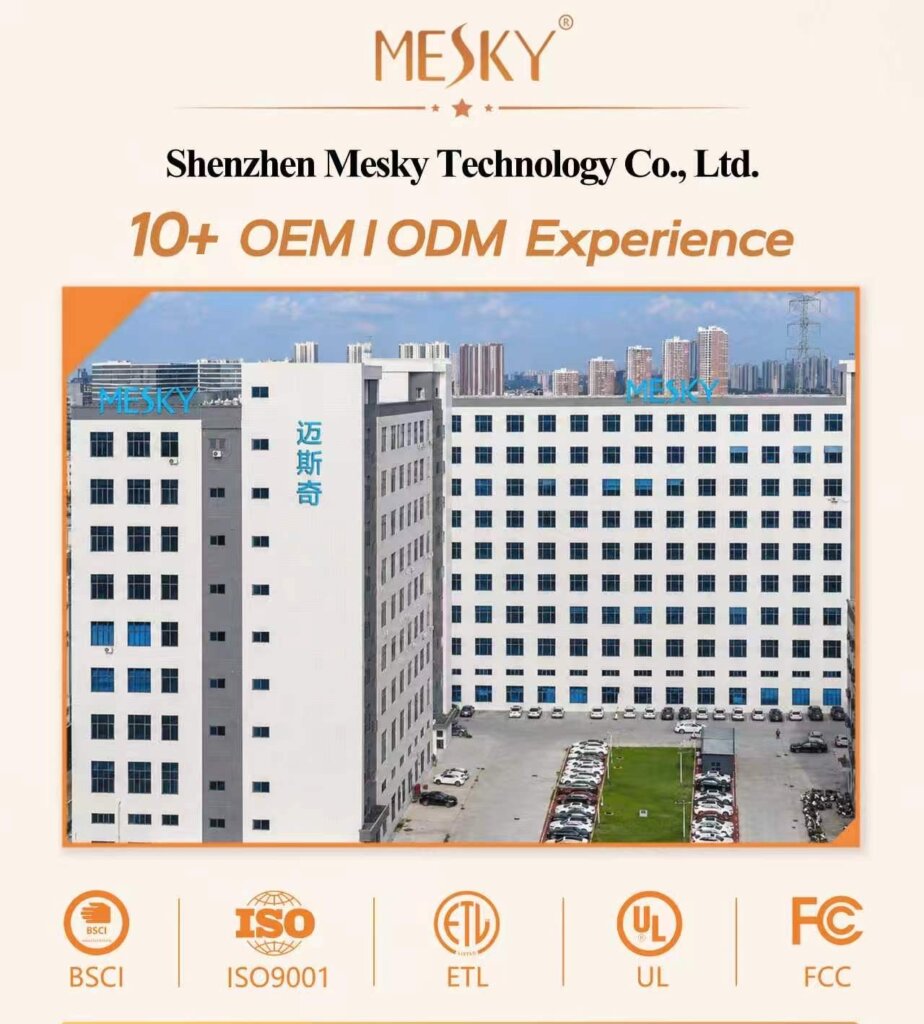
MESKY works with B2B buyers across Europe, North America, South America, and the Middle East.
Electrical and regulatory requirements can vary by country.
Buyers should confirm the required product configuration and documentation for their specific destination market rather than assume that a model suitable for one market is automatically suitable for another.
10. MESKY Titanium and Ceramic Hair Straightener Options
MESKY offers hair straightener models for OEM/ODM and private label projects.
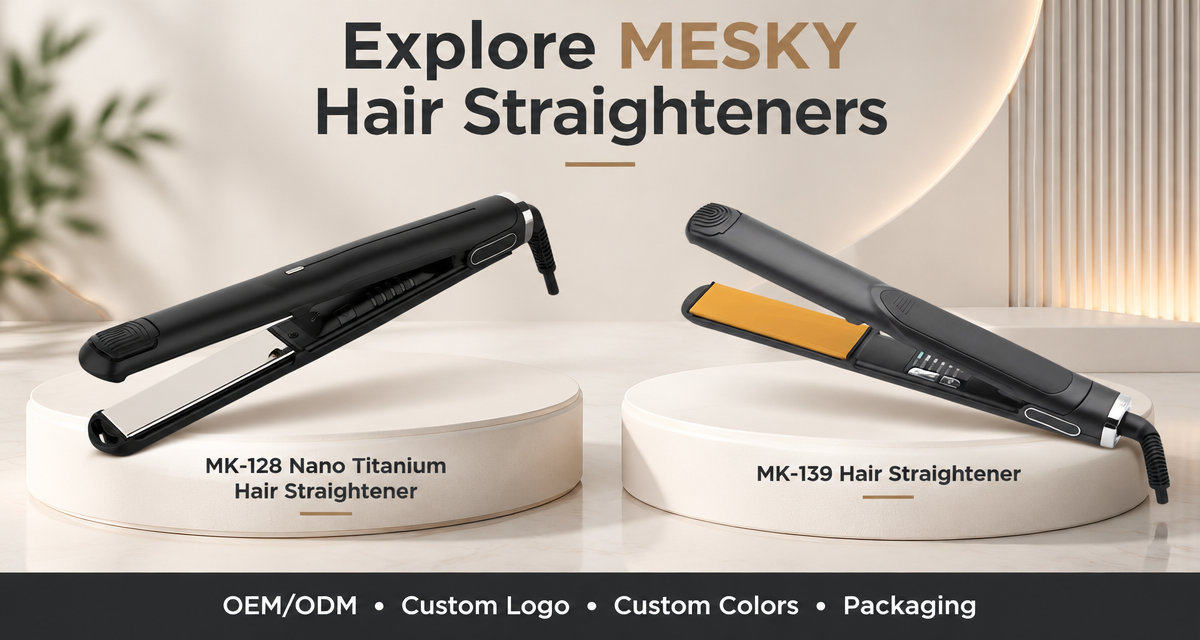
MK-128 Nano Titanium Hair Straightener
The MK-128 is a nano titanium straightener featuring MCH heating, five temperature settings, automatic dual voltage, and a 60-minute automatic shut-off function.
It is an option for brands and distributors evaluating titanium-based straighteners with OEM customization.
View MESKY MK-128 Nano Titanium Hair Straightener
MK-139 Wholesale Ceramic Flat Iron Hair Straightener
MESKY also lists the MK-139 in its wholesale flat iron range, with ceramic-related plate technology and OEM/ODM options.
Buyers should review the exact plate construction and selected configuration before placing an order.
Explore the MK-139 Wholesale Flat Iron
Compare More MESKY Straighteners
Brands that are still deciding between different plate technologies can review the wider product collection.
Browse MESKY Hair Straighteners
For information about custom logos, product colors, and packaging, see our Hair Styling Tools Customization Guide.
11. Frequently Asked Questions
Is Titanium or Ceramic Better for a Hair Straightener?
Neither is universally better. Titanium and ceramic have different material properties, but heating performance, temperature control, plate construction, and styling needs are also important.
Is Titanium Better Than Ceramic for Thick Hair?
Titanium straighteners are often considered for thick or coarse hair. However, suitable temperature control and overall product performance matter more than plate material alone.
Is Ceramic Better for Fine Hair?
Ceramic straighteners are commonly considered for fine hair, but users should still choose an appropriate temperature and avoid excessive heat exposure.
Which Heats Up Faster: Titanium or Ceramic?
Heat-up speed depends on the complete heating system, not only the plate material. Buyers should compare model-specific heat-up specifications.
Does Titanium Damage Hair More Than Ceramic?
Neither material determines damage risk on its own. Temperature, contact time, repeated passes, hair condition, and styling technique are significant factors.
Do Titanium Straighteners Last Longer?
Not necessarily. Durability depends on plate construction, surface quality, component design, and usage conditions.
Are Ceramic Straighteners Cheaper Than Titanium Straighteners?
Not always. Pricing varies by product design, features, quality requirements, brand positioning, and purchase quantity.
Can MESKY Customize Titanium and Ceramic Hair Straighteners?
MESKY provides OEM/ODM customization services for hair straightener products. Available plate configurations, logos, colors, electrical options, and packaging should be confirmed for the selected model.
What Should an Importer Confirm Before Ordering?
Confirm the model, plate construction, heater, temperature settings, voltage, plug, customization requirements, quantity, warranty terms, and applicable documentation for the destination market.
12. Final Verdict: Titanium or Ceramic Hair Straightener?
The better hair straightener is the one whose overall design meets the intended styling requirements.
Titanium is a useful option for flat iron designs requiring a smooth metal-based plate surface and efficient thermal transfer. Ceramic is also widely used in straighteners and can provide a smooth styling surface across different product designs.
Neither material alone guarantees faster heating, less damage, better temperature accuracy, or longer product life.
For consumers, appropriate temperature control and proper styling practices are essential.
For beauty brands, distributors, and importers, choosing between titanium and ceramic should involve comparing complete product specifications, quality control, and target-market requirements.
Looking for an OEM/ODM Hair Straightener Supplier?
MESKY supports hair straightener sourcing and customization for private label beauty brands, wholesale distributors, and importers.
Share your preferred plate material, product configuration, destination country, estimated quantity, and branding requirements so our team can review suitable options.
Request a Hair Straightener OEM/ODM Quote
Last Updated on 11/05/2026 by sales04